
Party Wall Notice Periods in London

Party Wall Notice Periods in London

Party wall timelines are one of the most common reasons London projects slip before work even starts. People plan the build programme, book trades, order materials, then realise the party wall notice period does not line up with the start date.

It is rarely complicated, but it is strict. If the notice is served late, or served incorrectly, the clock can restart. If a neighbour does not respond, the process can move into a dispute route and take longer than expected.

This guide explains the notice periods that apply in London, what can extend them, and how to plan the process so your project can start when you need it to.

Why notice periods matter on London projects

London refurbishments often involve tight access, shared walls, older building stock, and neighbours living close by. The party wall process exists to protect both sides, but it also introduces lead time that you need to account for.

The notice period is not the full timescale. It is the earliest date you can start the relevant works if everything runs smoothly. If surveyors need to be appointed and an award is required, the programme becomes longer.

Projects move faster when the early admin is correct, which is why the steps for how to serve a party wall notice matter more than most people expect.

aThe standard party wall notice periods


There are two main notice periods under the Party Wall etc Act 1996. Which one applies depends on the type of work.

Two months notice

A two month notice period applies to works directly affecting a party wall or party structure. Common examples include:

  • Cutting into a party wall to insert steel beams
  • Raising, thickening, or rebuilding a party wall
  • Works to a party structure such as floors or ceilings in some types of buildings
  • Removing chimney breasts attached to a party wall
  • Underpinning a party wall

This is a common notice period for loft conversions and structural refurbishments in London terraces.

One month notice

A one month notice period usually applies to excavation works near a neighbouring building, including works for new foundations.

This often affects rear extensions and basement works, where you are digging near a neighbouring property within the distance and depth thresholds set by the Act.

Many London homeowners assume excavation notice is part of the same two month rule, but it is a separate notice type and needs to be handled correctly.

The notice period is the minimum, not the total time

A valid notice does not mean work can start automatically on the earliest date. It means the legal notice requirement has been satisfied, assuming the correct steps are followed.

The total time depends on how the adjoining owner responds.

If the neighbour consents quickly, the process can be straightforward.

If the neighbour dissents or does not respond, surveyors are appointed and the award route begins. That route is managed through party wall matters and is where timeframes become less predictable.

What happens after you serve notice

Once notice is served, the adjoining owner has a window to respond. If they consent in writing, that often keeps the programme tighter.

If they dissent, or if they do not respond, surveyors need to be appointed. No response is treated as dissent under the Act, which is why it can be risky to assume silence means agreement.

London projects often involve landlords, managing agents, or absentee owners, so response delays are common.

A practical view of this from the receiving side is covered in what to do if served a party wall notice, which is useful because it reflects the choices your neighbour is weighing up.

How long does the award route usually take

The award route timeline varies because it depends on complexity, the information available, and how quickly both sides engage.

Common factors that extend timelines include:

  • Incomplete drawings or unclear scope
  • Structural changes that need more detail
  • Basement works and underpinning
  • Access constraints and neighbour concerns
  • Multiple adjoining owners
  • Managing agents requiring formal approvals
  • Busy periods where surveyors and structural engineers have lead times

In simple cases, an award can be agreed quickly once surveyors are appointed. In more complex cases, it can take longer, particularly if method statements, sequencing, and protective measures need more detail.

A clearer understanding of what the award is and how it works sits within the Party Wall Act explained, which helps when you are trying to plan realistically rather than optimistically.

Common ways people lose time without realising

Most party wall delays come from avoidable issues.

Serving the wrong notice

If the notice does not match the works, it can be challenged or treated as invalid. That can lead to starting again and losing time.

Missing a relevant adjoining owner

In flats and mixed use buildings, ownership is often more complex than expected. If notice is not served on the right party, the process can be stalled.

Poor descriptions of works

Vague descriptions create hesitation, and hesitation leads to dissent and surveyor appointment. Clear detail helps neighbours understand risk and feel reassured.

Leaving it until the contractor is ready

By the time builders are booked, it is often too late to fit the notice period into the programme without pressure. Serving notice early is usually less stressful, even if your design is still being finalised.

Planning your programme around notice periods

A simple way to plan is to work backwards from the date you want to start on site.

If your works need two months notice, you want notice served earlier than that, because you need time for neighbour response, possible surveyor appointment, and the award process if required.

If your project is likely to trigger neighbour concerns, the award route is more likely, and you should plan with that in mind rather than hoping for a consent route.

Can you start work before the notice period ends

Starting the relevant works before the notice period ends is risky.

If the adjoining owner takes issue, they may seek to stop works, and that can create a much bigger delay than waiting.

Even if your neighbour appears relaxed, starting early can change the tone of the relationship and trigger formal action. It is usually not worth it.

What happens if your neighbour agrees to shorten the timeline

Some neighbours are happy to consent quickly, but the notice period itself is still part of the Act.

If the adjoining owner gives written consent, the project can often proceed without an award once the notice is valid, but it is still sensible to treat condition and communication seriously because most disputes start with misunderstandings rather than actual damage.

How F and T helps keep party wall timelines realistic

Party wall processes tend to move fastest when the notices are correct, the scope is clear, and the early steps are handled properly.

Fresson and Tee supports clients through party wall matters by helping keep notice preparation accurate, managing surveyor appointment when needed, and ensuring the steps are aligned with the project programme so start dates are realistic rather than hopeful.

If you would like to discuss more about construction consultants and contractors in London, please call our office on 020 7391 7100 or email us at surveyor@fandt.com.


Read More >

Can You Do Your Own Party Wall Agreement

Can You Do Your Own Party Wall Agreement

If you’re planning building works in London, it’s normal to wonder whether you can handle the party wall process yourself. It can feel like one more layer of admin when all you want is to get on site and start.

In simple cases, you can deal with parts of it without professional help. In other cases, it becomes a formal process under the Party Wall etc Act 1996, and that’s where DIY starts to fall apart.

This guide breaks down what you can do yourself, what you cannot, and how to avoid delays that end up costing more than doing it properly in the first place.

Quick Answer

Yes, you can serve a party wall notice yourself and you can reach written consent with a neighbour.

No, you cannot create your own party wall award if your neighbour dissents or does not respond. Once there’s a dispute, the Act requires a surveyor to produce the award through the party wall matters process.

What People Mean by a Party Wall Agreement

Most homeowners use “party wall agreement” to describe any written permission between neighbours.

Under the Act, there are two outcomes that matter. 

Consent

Your neighbour agrees in writing and you can proceed without an award, as long as the notice has been served correctly and covers the works properly.

Dispute

Your neighbour dissents, asks for a surveyor, or does not respond. That triggers a dispute under the Act and leads to a party wall award being put in place.

A lot of confusion comes from not knowing where that line sits, so it’s worth understanding how the Party Wall Act works before you start sending notices.

What You Can Do Yourself

You can take care of the early steps yourself, but only if you’re confident about accuracy and timing.

You can check whether the Act applies

The Act typically applies when you’re working on a shared wall or boundary structure, or excavating close enough to a neighbouring building that it could affect their foundations.

Loft conversions and rear extensions are common triggers because beams often bear into party walls and excavation is often needed for new footings.

You can serve the party wall notice

You do not need to pay a surveyor just to serve notice, but the notice has to be valid. That means the correct information, clear description of works, and the correct notice period.

A notice that is missing key details can be challenged, ignored, or treated as invalid, which means starting again and losing time.

Many delays come from simple admin errors, which is why the steps for how to serve a party wall notice are worth following carefully before anything is issued.

You can agree written consent

If your neighbour is comfortable with the works and gives written consent, you may be able to proceed without surveyors.

Even with consent, it is still sensible to record condition before work starts. Not because you expect conflict, but because older London properties often have existing cracking and movement, and memories get hazy once noisy work begins.

What You Cannot Do Yourself

There is a point where the law takes over and DIY is no longer an option.

You cannot write your own party wall award

A party wall award is a legal document produced by an appointed surveyor under the Act. If your neighbour dissents or does not respond, you cannot replace that with a document you write yourself, even if both sides sign it.

You cannot act as the surveyor in a dispute

Once there’s a dispute, surveyors are appointed to act impartially under the Act. The building owner cannot appoint themselves. If you get to this stage, it becomes a surveyor led process by definition, which is exactly what the party wall matters service is set up to handle.

What Happens After You Serve Notice

Once a valid notice has been served, the adjoining owner can respond in several ways.

Option 1

They consent in writing

If they consent, works can proceed. Practical issues still need to be managed, such as access, working hours, and how you will handle noise, dust, and protection.

Option 2

They dissent and appoint their own surveyor

Two surveyors are involved, one for each party, and they agree the award together.

Option 3

They dissent but agree to one surveyor

An agreed surveyor can act for both parties as long as both sides accept that the surveyor must remain impartial.

Option 4

They do nothing

No response is treated as dissent. That means surveyors need to be appointed and the award process begins.

Being on the receiving end of notice often feels confrontational, but the response options set out in what to do if served a party wall notice are designed to protect both sides, not to block reasonable works.

When DIY Usually Works

Handling the early steps yourself tends to work when the project is straightforward and the neighbour relationship is stable.

It is more likely to go smoothly when:

The works are low risk

The neighbour responds quickly

You have time in the programme

The notice is accurate

Condition is recorded properly

Where those conditions are in place, a written consent route can be efficient.

When DIY Becomes Expensive

DIY becomes risky when any of the following apply.

The programme is tight

If you are trying to start quickly, a single invalid notice can push your start date back. That is often the first reason DIY becomes costly, because delays add contractor prelims, storage costs, and rescheduling issues.

The works are higher risk

Basements, underpinning, major structural changes, and deep excavations often lead to surveyors getting involved even when neighbours are friendly. People want proper safeguards because the potential impact is bigger.

The neighbour is a landlord or managed building

If the adjoining property is owned by a landlord or managed by an agent, you will often find they prefer a formal award route. Informal agreements are less common because they need a clear paper trail and defined responsibilities.

The property already has visible defects

Existing cracks, past movement, and historic repairs are common in London buildings. Without a record of condition, it becomes harder to separate pre existing issues from new damage, which is a common reason party wall processes turn sour.

There are multiple adjoining owners

Flats and mixed use buildings can require notices to multiple parties. It is easy to miss someone or serve the wrong person, which can create last minute complications.

The Most Common Mistake

The biggest mistake is assuming a friendly conversation counts as agreement.

A neighbour saying “that should be fine” is not written consent under the Act. If there is no valid notice and no written consent, the adjoining owner has stronger options to stop works, and the project can become more difficult than it needs to be.

Most people want things to stay friendly. The way to do that is clarity, correct notices, and a process that feels fair to both sides.

What a Surveyor Adds in Real Terms

People often assume a party wall surveyor is there to produce paperwork. In practice, they help reduce uncertainty and stop small issues becoming disputes.

A party wall surveyor will typically:

Confirm what notices apply

Check timing and notice detail

Record the adjoining owner’s condition

Review drawings and methods from a risk perspective

Set working safeguards in the award

Agree access arrangements if needed

Define how damage is assessed and resolved

That structure protects both owners and often keeps the project moving.


How F and T Supports the Process

Some clients need help because a neighbour has dissented and they need an award completed correctly. Others want certainty before they serve notice so they do not lose time.

Fresson and Tee supports building owners and adjoining owners through party wall matters, keeping notices correct, managing disputes when they arise, and protecting the project programme so works can proceed with fewer surprises.

If you would like to discuss more about construction consultants and contractors in London, please call our office on 020 7391 7100 or email us at surveyor@fandt.com.

Read More >

The Most Common Defects Found in Dilapidation Surveys

The Most Common Defects Found in Dilapidation Surveys

Dilapidations can feel like a catch all term until you are dealing with them properly. One day it is business as usual, then suddenly there is a schedule listing dozens of items with costings attached, and every mark on a wall looks like it has a price tag. Tenants often feel like they are being blamed for every imperfection. Landlords often feel like they are being handed a property that is not ready for the next occupier.

What usually surprises people is how predictable dilapidation schedules are. Most claims are built around the same types of defects, and once you know what they are, you can spot them early and deal with them before they turn into a bigger issue.

If you are approaching lease end, or you manage a portfolio and want fewer disputes, the best thing you can do is understand what surveyors tend to pick up and why. In many cases, an early review supported by dilapidations survey advice can prevent the last minute rush that drives costs up for everyone.

Why The Same Defects Show Up Again and Again

Most commercial buildings age in ways that are fairly consistent. High footfall areas wear first. Services are often forgotten until something fails. Minor leaks become staining, then damaged finishes. Alterations made for operational reasons are sometimes left without proper making good. None of this is unusual. The problem is that lease end inspections shine a light on all of it at once.

Leases also push defects to the surface. If the lease includes repair obligations, redecoration cycles, or reinstatement requirements, surveyors will check whether those have been met. This is why a property that feels usable day to day can still trigger a long schedule when the tenant is leaving.

A good starting point is to treat lease end like a planned project, not a sudden event. That is where coordinated programmes and sensible planning come in, and it is often easier when project management support is involved early enough to coordinate inspections, contractors, and access.

Decorative Condition And Tired Finishes

Decoration is one of the most common categories in dilapidations schedules, and it is also one of the easiest areas to underestimate.

Surveyors regularly flag scuffed walls, worn paint finishes, discoloured ceilings, patchy touch ups, and failed sealant around skirting and frames. In offices this often shows up at corners, meeting rooms, and around radiator points. In retail and hospitality environments, high contact zones get marked quickly, especially near entrances, counter areas, and staff spaces. 

Decoration becomes a claim issue because many leases include an obligation to redecorate periodically, often every few years, and sometimes again at lease end. If that cycle has been missed, a surveyor can justify it as a clear breach. Even when the overall space is clean, inconsistent finishes or visible making good repairs can be enough to trigger redecoration items.

If you are a tenant, decoration is one of the areas where early action can save money. Painting a space when you still have access and time is usually cheaper than being pushed into last minute contractors. If you are a landlord, consistent decorative condition matters because it affects how quickly the space can be marketed.

Flooring Wear And Damage

Floors take a lot of punishment, and they almost always appear in schedules in some form.

Carpets become worn and stained in circulation routes, around desks, and in meeting rooms. Vinyl can split or peel, particularly in kitchenettes, corridors, and entrance areas where water and dirt build up. Timber floors can show scratches, water staining, and movement that creates gaps or uneven boards.

The key issue is not that floors are used, it is whether the condition breaches the lease standard. If the lease allows fair wear and tear, some deterioration may be acceptable. If the lease is stricter, or if the flooring was specified to be returned in good order, the defect list can grow quickly.

Where a schedule of condition exists from the start of the lease, it can be the difference between a fair discussion and a costly argument. Without a baseline, tenants often struggle to prove what was pre existing, which can inflate exposure.

Water Ingress, Staining, And Damp Related Defects

If there is one category that can turn into a costly headache, it is water.

Surveyors commonly flag ceiling staining, bubbling paint, mould around window reveals, damaged plaster, and signs of persistent moisture around bathrooms, plant areas, and poorly ventilated corners. Some defects look cosmetic but suggest a bigger issue behind the surface, and surveyors tend to record them as potential disrepair even if the root cause is not obvious.

Responsibility depends on the lease. Some tenants are responsible for internal finishes only. Others have broader obligations that include elements of the structure or external envelope. This is one reason why building consultancy needs to be handled with care, because damp and water issues often sit between internal condition and external maintenance.

If you are dealing with buildings where heritage fabric, sensitive detailing, or older construction methods are involved, damp related claims can become more complex. In those situations, the approach needs to consider the building type and the correct repair method, which may sit alongside specialist input such as historic building conservation support where appropriate.

Mechanical And Electrical Servicing Issues

Services are often where costs jump unexpectedly, partly because the issues are not always visible until you test or inspect properly.

Surveyors frequently note missing servicing records for heating, ventilation, and extraction systems. They may record poor performance, broken controls, noisy fan units, or systems that have clearly not been maintained. Electrical issues can include damaged sockets, missing covers, old lighting, and ad hoc additions that do not look compliant or professionally installed.

Even where defects are minor, the lack of records can trigger additional requirements such as testing and certification. Landlords often want assurance that the systems are safe before re letting, and if the tenant has not maintained documentation, the schedule may include the cost of bringing systems up to a standard that can be demonstrated.

For tenants, this is a reminder that keeping servicing up to date is not just good practice, it is also a cost control measure. For landlords, it is a reminder that clear expectations in the lease and proactive communication during the tenancy can prevent last minute disputes.

Poor Making Good After Alterations

Alterations are a major driver of dilapidations schedules, especially in office fit outs.

Tenants may add partitions, install new cabling routes, adjust lighting, introduce kitchenettes, or change layouts to suit operations. Even where the landlord has provided consent, reinstatement obligations often apply at lease end.

Surveyors regularly flag patchy making good, exposed fixings, uneven wall finishes, ceiling grids that have been disturbed, and areas where previous installations have left visible marks or damaged surfaces. Sometimes nothing is unsafe, it just looks incomplete, and that is enough to become a claim item.

The financial impact often comes from the scale of reinstatement. It is rarely one partition. It is the combined effect of multiple changes over time, especially when the tenant has moved things around more than once.

If reinstatement works are likely, planning them as a proper package of works rather than a rushed set of tasks can reduce cost. That is where coordinated delivery and project management oversight can help, particularly when access, sequencing, and contractor scheduling affect overall spend.

Poor Making Good After Alterations

Alterations are a major driver of dilapidations schedules, especially in office fit outs.

Tenants may add partitions, install new cabling routes, adjust lighting, introduce kitchenettes, or change layouts to suit operations. Even where the landlord has provided consent, reinstatement obligations often apply at lease end.

Surveyors regularly flag patchy making good, exposed fixings, uneven wall finishes, ceiling grids that have been disturbed, and areas where previous installations have left visible marks or damaged surfaces. Sometimes nothing is unsafe, it just looks incomplete, and that is enough to become a claim item.

The financial impact often comes from the scale of reinstatement. It is rarely one partition. It is the combined effect of multiple changes over time, especially when the tenant has moved things around more than once.

If reinstatement works are likely, planning them as a proper package of works rather than a rushed set of tasks can reduce cost. That is where coordinated delivery and project management oversight can help, particularly when access, sequencing, and contractor scheduling affect overall spend.

External Areas, Drainage, And Building Envelope Defects

Depending on the lease type, external defects can appear in a schedule and cause disputes quickly.

In some leases, the tenant responsibility stops at the internal demise. In others, especially full repairing obligations, external doors, signage fixings, drainage points, and even parts of the facade may be included.

Surveyors often record blocked gullies, damaged steps, cracked paving, loose handrails, failed seals to external doors, and defects that present safety risks. Even when items look minor, landlords may push them because they affect compliance and liability.

In multi occupied properties, external works can also involve access and neighbour coordination. If the defect relates to shared walls or party structures, timelines and responsibilities can become complicated, and this is where party wall matters can affect delivery and cost exposure.

Fire Safety And Compliance Related Defects

Compliance appears frequently in schedules because landlords want the property to be lettable without delays.

Surveyors may record damaged fire doors, missing signage, incomplete records, and poor fire stopping around service penetrations. They may also flag alterations that compromise compartmentation, such as cabling that has been routed through walls and ceilings without proper sealing.

The cost impact often comes from specialist remedial works and the need for compliant certification. These are not always expensive items individually, but they can delay handover and create pressure at the worst time.

For tenants, this reinforces the importance of not treating compliance as an afterthought. For landlords, it highlights why consistent inspections during the lease can prevent large issues landing at lease end.

Plumbing And Sanitary Defects

Plumbing defects are common, particularly in older commercial buildings or spaces with frequent staff use.

Surveyors frequently flag leaking taps, failed seals, damaged sanitaryware, poor drainage, and water damage around kitchenettes and toilets. These issues are often seen as avoidable, which is why they show up repeatedly in schedules.

Plumbing defects can also cause knock on damage to floors, joinery, and adjacent finishes, which then appears in the schedule as multiple items rather than one.

What This Means For Tenants

If you are a tenant, the practical takeaway is simple. Most dilapidation costs come from predictable defects that can be managed earlier with planned maintenance and a pre exit review.

If you wait until the landlord schedule lands, you will be reacting. If you review the property in advance with experienced dilapidations surveyors, you can make decisions calmly, prioritise what matters, and negotiate from evidence rather than pressure.

What This Means For Landlords

If you are a landlord, knowing the common defect categories helps you prepare realistic schedules and reduce disputes. Clear evidence and proportional claims lead to quicker settlements, fewer void periods, and smoother re letting.

If you are also managing insurance exposure and asset risk, dilapidations often sits alongside wider assessments. In some cases, linking lease end condition discussions with building reinstatement cost assessments can support broader decision making around risk, refurbishment planning, and portfolio value.

If you would like to discuss more about construction consultants and contractors in London, please call our office on 020 7391 7100 or email us at surveyor@fandt.com.

Read More >

How to Save Money on Dilapidation Claims With the Right Survey

How to Save Money on Dilapidation Claims With the Right Survey

Dilapidation claims can feel like a nasty surprise at the end of a lease. You might already be dealing with a move, a handover, a new fit out, or the practical headache of closing a site. Then a claim arrives listing repairs, decoration, reinstatement, and a long line of costs that look non negotiable.

In reality, a dilapidation claim is rarely as fixed as it first appears. The final figure usually comes down to evidence, timing, and whether the right people are involved early enough. If you want to keep costs under control, the most useful thing you can do is get the right survey in place before assumptions take over.

This is true whether you are a tenant trying to reduce exposure or a landlord trying to recover a property without months of back and forth.

Why dilapidation claims get expensive so quickly

Most overspending in dilapidations comes from one of three situations.

First, people leave it too late. Once the lease end date is close, choices narrow. Contractors cost more when they are rushed, works become harder to manage, and decisions are made under pressure.

Second, the lease is not being interpreted properly. Commercial leases can be unforgiving, but they are also specific. If a claim is built on the wrong interpretation, it is easy for costs to inflate.

Third, one side is working without decent evidence. A tenant who does not have an informed response often ends up agreeing to items they do not actually owe. A landlord who issues a claim that cannot be supported often triggers a dispute that delays re letting.

A proper dilapidations survey is designed to stop all of this before it spirals.

What the right survey actually does

A dilapidations survey is not just a defect list. It ties the condition of the property back to the obligations in the lease, then sets out what is likely to be enforceable and what is likely to be challenged.

That distinction matters.

A standard condition report might say a wall finish is worn. A dilapidations survey asks a different question. Is the tenant required to redecorate under the lease. Was the wall already worn at the start. Is this wear consistent with normal use. Is the claim asking for improvement rather than reinstatement.

When you work with a specialist team like Fresson and Tee’s dilapidations surveyors, the output is practical. It gives you a clear view of what can be defended, what should be negotiated, and what would genuinely be cheaper to put right.

Save money by starting earlier than you think you need to

If you are a tenant, the best time to instruct a surveyor is not when the schedule arrives. It is months before lease end, while you still have options.

An early survey gives you breathing room. You can prioritise the items that might genuinely matter, get realistic quotes, and avoid paying inflated rates for last minute works. More importantly, you can decide whether doing the works is even the right move.

Landlords benefit from early action too. If you know a tenant is leaving, getting an informed view early helps you plan the next stage, especially if you are coordinating refurbishment, re letting, or a change of use. That is often where good project management support becomes valuable, because the dilapidations conversation can be aligned with the delivery plan rather than treated as a separate fight.

The most expensive mistake tenants make

The biggest cost mistake is assuming the landlord’s schedule is the final bill.

Schedules are a starting position. They are often written conservatively, sometimes aggressively, and they can include items that are open to interpretation. Tenants who accept everything without a specialist response often pay for work they did not need to do, or agree to a settlement that could have been reduced with evidence.

A survey helps you respond line by line in a controlled way. It also helps you spot common problem areas, such as items that look like fair wear and tear being treated as disrepair, or reinstatement items

Negotiation is often where the real savings are

Some tenants think a claim can only be solved by carrying out the work. In practice, many end of lease outcomes are settled financially.

There are plenty of reasons for this. A landlord might want the keys back quickly. They may plan to refurbish anyway. They may not want contractors on site while marketing the space. Tenants often want certainty so they can close the lease chapter and focus on the next premises.

A survey supports that settlement conversation in a grounded way. Instead of arguing opinions, you are discussing evidence, scope, and realistic cost. That alone can strip out inflated items and bring the figure closer to what is actually defendable.

From a landlord’s point of view, this also reduces risk. If a schedule is pushed too hard, it often slows everything down. A more proportionate claim, backed by professional assessment, is more likely to settle quickly and allows the property to move forward.

Why a normal building survey does not solve dilapidations

This catches people out.

A building survey might be excellent for understanding condition, but it is not designed to interpret lease liability. It does not usually consider how clauses are applied in practice, or how a claim might be limited by the landlord’s actual loss.

Dilapidations sits in a slightly awkward space between building condition and lease enforcement. That is why specialist experience matters. It is also why multidisciplinary firms tend to handle these situations more smoothly, because they can draw on wider knowledge around refurbishment planning, compliance, and delivery.

If dilapidations works are likely to run alongside other building decisions, linking the conversation to broader cost planning can be useful, including items like building reinstatement cost assessments where insurance and rebuilding costs are part of the wider picture for owners and asset managers.

Landlords can reduce costs too, not just tenants

It is easy to assume dilapidations is only a tenant problem. It is not.

Landlords can lose money through delays, void periods, and disputes that drag on. Even when a claim is valid, a poorly structured schedule can push the situation into conflict. A realistic, well supported approach often achieves better outcomes than trying to claim for everything possible.

There is also a practical angle. If a property is in a building with shared responsibilities, access constraints, or neighbour sensitivities, dilapidations related works can become harder and more expensive than expected. In those cases, it helps when surveyors and project teams can factor in connected issues like party wall matters, because that can affect timing and cost exposure.

What to expect from a strong survey process

A good process feels calm and structured, even if the claim is not.

You should expect a surveyor to:

  • Review the lease properly, not just skim it
  • Inspect the property with a clear scope
  • Photograph and document relevant condition points
  • Cost items realistically rather than defensively
  • Explain where a claim is strong, weak, or commercially unrealistic
  • Support negotiation with facts rather than threats

For tenants, that usually translates into fewer surprises and a clearer route to settlement. For landlords, it means a claim that is more likely to be taken seriously and resolved sooner.

The real value is certainty

People focus on the headline figure, but the hidden savings often come from certainty.

When you know where you stand, you stop making rushed choices. You avoid agreeing to unnecessary works. You avoid calling in solicitors too early. You avoid weeks of emails going nowhere because nobody has a shared set of facts.

A well prepared survey does not just reduce the final number. It makes the whole process more predictable, which is often what clients want most when a lease is ending.

Speak to our team today about your property survey needs, please call our office on 020 7391 7100 or email us at surveyor@fandt.com.

Read More >

The Difference Between a Building Survey and a Dilapidation Survey

The Difference Between a Building Survey and a Dilapidation Survey

If you’ve ever looked into property assessments, you’ve likely come across two terms that sound similar but mean very different things: building surveys and dilapidation surveys. Understanding the distinction between them isn’t just useful—it’s essential if you’re buying, leasing, or managing property.

Let’s break it down clearly, without the jargon.

What Is a Building Survey?

A building survey is a comprehensive inspection of a property’s condition. It’s typically carried out before a property is purchased, especially if it’s older or has visible signs of damage. The aim? To highlight existing defects and potential issues that might crop up down the line.

A building survey looks at:

  • Structural integrity
  • Roof condition
  • Damp, rot or subsidence
  • Internal and external fabric
  • Mechanical and electrical systems

It gives the prospective buyer peace of mind and often helps in negotiating the price or planning for future maintenance costs.

Useful if you’re:
Buying an older or non-standard property, planning a renovation, or just want a clear picture of what you’re getting into.

What Is a Dilapidation Survey?

A dilapidation survey—sometimes called a Schedule of Dilapidations—is a different beast entirely. This survey focuses on how well a tenant has kept a leased commercial property. It’s typically done at the end of a lease term or during it (interim), and it helps determine if the tenant is responsible for repairs or reinstatement works under their lease obligations.

A dilapidation survey assesses:

  • Breaches of lease covenants (e.g. repair, decoration, reinstatement)
  • Damage or deterioration beyond fair wear and tear
  • Any alterations made without landlord’s consent
  • Required remedial works and associated costs

Landlords use the report to support a claim, while tenants might commission one to defend against excessive charges.

Useful if you’re:
A commercial landlord or tenant nearing the end of a lease or in a dispute over repair liabilities.

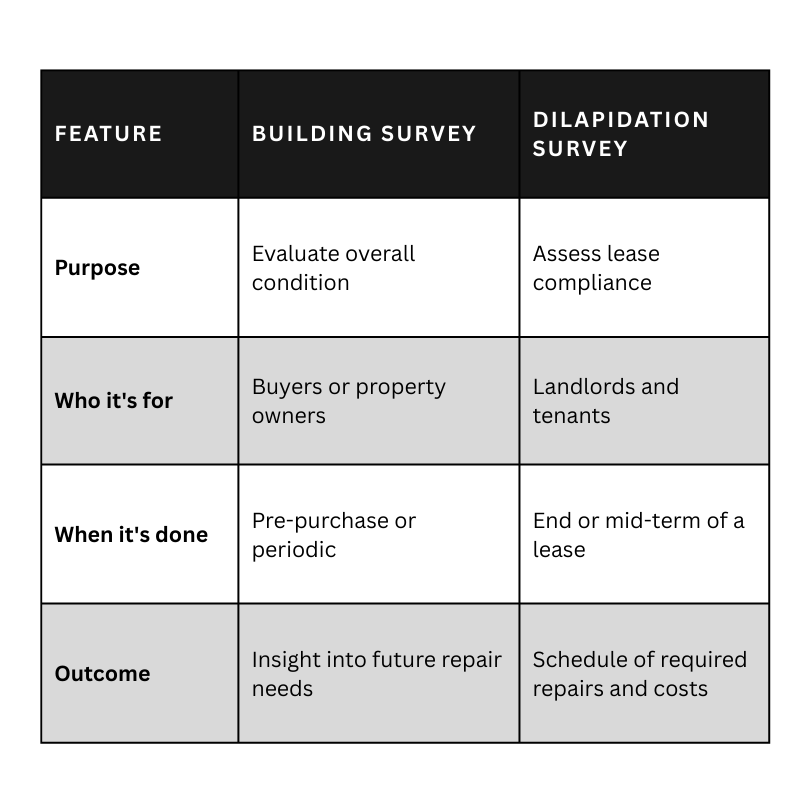
Key Differences at a Glance

Key Differences at a Glance

Do I Need Both?

Not usually. These surveys serve completely different purposes. If you’re buying a property, a building survey is your go-to. If you’re leasing one—especially commercial—a dilapidation survey will protect your interests either as the landlord or the tenant.

In some cases, landlords might commission both types of surveys over a property’s lifecycle—one to monitor overall condition, and another to ensure lease compliance.

Why It Matters

Confusing the two could cost you. A buyer relying on a dilapidation survey won’t get the full picture. A tenant ignoring dilapidations risks facing hefty repair bills. Knowing the right survey for your situation helps avoid disputes, surprises, and financial loss.

Need Help Navigating Surveys?

At Freeson and Tee, we support clients on both sides of the equation. Whether you’re preparing a property for sale or lease, responding to a dilapidation claim, or just need clarity, our experienced surveyors can guide you through it.

Speak to our team today about your property survey needs, please call our office on 020 7391 7100 or email us at surveyor@fandt.com.

Read More >

Who’s Responsible for Dilapidations in a Lease Agreement?

Who’s Responsible for Dilapidations in a Lease Agreement?

If you’re leasing a commercial property, you might have come across the term dilapidations. It refers to repairs or maintenance that a tenant may be required to carry out—either during the lease or at the end of it. But whose job is it really? Tenant or landlord?
Let’s break it down.

What Are Dilapidations?

Dilapidations cover the physical state of a rented property. They usually relate to the tenant’s failure to keep the premises in good condition, as outlined in the lease agreement. Think: broken light fittings, damaged plaster, worn carpets, or neglected maintenance.

A landlord might raise a schedule of dilapidations when they believe the tenant hasn’t kept to their obligations. This can happen during the lease or when the lease ends.

Who’s Responsible

So, Who’s Responsible?

In most cases, the tenant is responsible for dilapidations—but it all comes down to what’s written in the lease.

If the lease includes a full repairing obligation, the tenant must return the property in good condition, even if it wasn’t in great shape to begin with. But some leases limit that responsibility with things like a schedule of condition, which documents the property’s state at the start of the lease.

The landlord, on the other hand, is usually only responsible for structural issues or repairs that aren’t the tenant’s duty under the lease.

What Happens at the End of a Lease?

When a lease ends, landlords often serve a terminal schedule of dilapidations. This lists the repairs or reinstatement work the tenant is expected to carry out, along with estimated costs.

At this point, tenants can either:

  • Carry out the work themselves, or
  • Settle the claim financially (called a dilapidations settlement).

It’s not uncommon for this process to involve surveyors, legal reps, and sometimes negotiations about what’s fair.

Can Tenants Dispute a Dilapidations Claim?

Yes—and they often do.

Disputes usually arise when:

  • The landlord demands repairs that go beyond the tenant’s obligations
  • There’s no schedule of condition to show what the place was like at the start


  • The tenant believes the landlord won’t actually suffer a loss


This is where expert advice becomes crucial. A building surveyor can help determine the real cost and extent of necessary works, and a solicitor can help negotiate a fair outcome.

Why It Matters to Get This Right

Dilapidations claims can run into the tens—or even hundreds—of thousands of pounds. For tenants, getting the right advice early can protect against unexpected costs. For landlords, ensuring the lease is watertight and accurately reflects responsibilities helps avoid drawn-out disputes.

Final Tip: Read the Lease Carefully

The lease is king. Whether you’re signing, renewing, or coming to the end of a lease, make sure you understand the repairing and reinstatement clauses. If you’re unsure, don’t guess—speak to a legal advisor or property consultant who knows the ins and outs of dilapidations.

Why It Matters to Get This Right

FAQ Section

What are dilapidations in a lease agreement?

Dilapidations refer to the breaches of lease covenants relating to the condition of the property, typically involving disrepair or failure to maintain.

Who pays for dilapidations at the end of a lease?

Usually, the tenant is liable for dilapidations unless otherwise stated in the lease terms or if a Schedule of Condition limits liability.

Can dilapidations be negotiated?

Yes, many tenants successfully negotiate dilapidations claims, especially if the property has redevelopment potential or the claim is excessive.

What is a Schedule of Condition?

It’s a document with written and photographic evidence of the property’s state at lease commencement, used to limit future liability.

If you would like to discuss more about construction consultants and contractors in London, please call our office on 020 7391 7100 or email us at surveyor@fandt.com.
Read More >

What to Include in an Architectural Design Brief

What to Include in an Architectural Design Brief

If you’re planning a construction or refurbishment project in London, the first step isn’t hiring contractors or submitting planning applications. It’s building a solid architectural design brief. This document sets the direction for everything that follows, and the better it is, the smoother your project will go.

Why the Brief Sets the Tone

A brief is more than a to-do list. It gives your architect the tools to understand what you’re aiming to achieve. Without it, designs are built on assumptions and that usually leads to delays, cost overruns, and disappointment. A well-written brief helps keep your design aligned with your needs, avoids unnecessary revisions, and ensures your whole team is working from the same playbook.

At Fresson and Tee, we often get involved at this early stage, particularly when clients are unfamiliar with the process. Whether it’s a residential extension or a commercial retrofit, we help shape the brief in a way that’s realistic, structured, and futureproof. 

What to Include in Your Brief

architectural design project goals

1. Project Goals and Drivers

What’s the real reason behind this project? Is it to create more space, improve energy performance, adapt to new ways of working, or protect the value of a heritage asset? This kind of context allows your architect to balance practicality with what matters most to you.

2. Property and Site Information

Where is the project located? Is it a listed building, within a conservation area, or subject to restrictive covenants? Even simple details like access routes or party walls make a big difference. F&T’s architectural team regularly works with complex London sites, so we use this information to assess potential issues before they cause problems.

3. How the Space Needs to Work

Think about the people who’ll be using the space. How should it flow? What kinds of activities will take place? It’s not just about square footage. For residential projects, that could mean creating spaces that suit how you live, maybe a sociable kitchen-diner where family time happens, or a quiet corner to focus when working from home. For businesses, it’s about functionality and comfort for your team and visitors.

4. Style, Feel, and Materials

You don’t need to define every material or finish, but if you’ve got a feel in mind, let us know. That might be something you’ve seen in another building, or even just a mood,  whether you’re after something clean and contemporary, warm and textured, or more traditional in tone. Those preferences help shape the design language from the start.


5. Budget and Constraints

It’s really helpful to be open about your budget early on. That doesn’t limit creativity, quite the opposite. It helps us steer the design in a direction that works both visually and financially. If there are other limitations too, such as leaseholder restrictions, shared access, or tricky planning history, bring those into the conversation. The sooner we know, the more we can work around them.


6. Sustainability and Compliance

More clients are now asking us about energy performance, embodied carbon, and ways to build more sustainably. If you have any goals or expectations in this area, whether it’s to reduce running costs or achieve a certain certification, it’s best to mention them early so they’re integrated into the design.


architectural design buildings

7. Planning or Legal Factors

Already spoken to the council? Got a pre-app in place? Any party wall or leasehold issues looming? These all shape what’s possible. Fresson and Tee handles this daily — so if we know what’s on the table, we can bring in surveyors or legal consultants where needed.

How Fresson and Tee Support the Briefing Stage

Unlike “architect,” the term “architectural designer” is not legally protected. Anyone can use it – whether they’ve studied design or not. That doesn’t mean all designers are unqualified or inexperienced, but it does mean you need to do your research.

architectural design work with f and t

Many clients we work with aren’t entirely sure where to start, especially if this is their first time overseeing a refurbishment or development. That’s where we come in. Whether you’re a landlord, a small business owner, or a developer, we can help you get clarity before a single drawing is created.

We’ll work with you to define the purpose of the space, the challenges ahead, and the results you want. Because we have architectural designers, surveyors, and project managers under one roof, we’re able to take a rounded view, helping you create a brief that’s both inspiring and deliverable.

    If you would like to discuss more about construction consultants and contractors in London, please call our office on 020 7391 7100 or email us at surveyor@fandt.com.

    Read More >

    Architect vs Architectural Designer: What’s the Difference in London?

    Architect vs Architectural Designer: What’s the Difference in London?

    Many People Confuse the Two – But the Difference Matters More Than You Think

    In a busy, regulation-heavy city like London, the person you choose to design your space can have a huge impact on time, cost, planning success, and peace of mind. While the terms architect and architectural designer are often used interchangeably, they’re not the same job – and they don’t come with the same training, legal status, or accountability.
    So how do you know which one you need for your project? Let’s break it down.

    What Is an Architect?

    In the UK, the title “architect” isn’t just a job label – it’s a protected legal designation. That means only people who have completed a rigorous, multi-stage education and registration process can call themselves one.

    To become an architect, someone must:

    • Complete 5+ years of formal architectural education (typically RIBA Part 1, 2 and 3)
    • Work under supervision for a minimum of two years
    • Pass a final qualifying exam (ARB recognised)
    • Register with the Architects Registration Board (ARB)
    Architect vs Architectural Designer

    Once qualified, they’re legally accountable for the quality and safety of the work they produce and are bound by a code of professional conduct.

    In real terms, a London architect can:

    • Design your project to a high standard
      Guide you through complex planning approvals
    • Liaise with structural engineers, surveyors, and builders
    • Ensure your designs meet strict local building and safety regulations
    • Take responsibility for the full architectural process from concept to completion

    You’re not just getting someone with design skills – you’re hiring a trained, regulated professional who understands how London works.

    So What Is an Architectural Designer?

    Unlike “architect,” the term “architectural designer” is not legally protected. Anyone can use it – whether they’ve studied design or not. That doesn’t mean all designers are unqualified or inexperienced, but it does mean you need to do your research.

    Some architectural designers in London are highly skilled, with design degrees or technical drawing experience. Others may focus more on concept visuals, extensions, or interior space planning. Many work under architects or as part of wider building consultancy teams.

    However, most cannot:

    • Submit complex planning applications independently
    • Sign off on technical or structural changes
    • Be held legally accountable for architectural errors
    • Offer the same level of assurance in insurance, contracts or regulation compliance
    Architectural Designer

    Real-World Example: London Planning Permission

    Real world planning

    Let’s say you’re converting a townhouse in Islington into flats.

    You’ll need:

    • Detailed elevation drawings
    • A strong case for planning
    • Understanding of daylighting, fire safety, and amenity space
    • A knowledge of local planning constraints (heritage, Article 4 directions, etc.)
    • Someone to speak with the council on your behalf

    A registered architect has the training and professional standing to handle this. A designer may be able to support the visual and layout side of the project, but likely won’t have the credentials to see it through independently.

    What About Costs?

    Architectural designers often charge less than architects – which makes them appealing for simple home projects. If you just want to explore design ideas or visual layouts, that might be enough.

    But cost shouldn’t be your only consideration. In London, where planning rules vary dramatically from one borough to the next, investing in an architect often saves time, money, and stress in the long run.

    Mistakes in planning drawings, poor understanding of building regs, or lack of experience in dealing with structural issues can cause delays, refusals, or worse – costly construction errors that need fixing later.

    Do You Always Need an Architect?

    Not always.

    If you’re redesigning a kitchen layout, making non-structural changes, or just want help with visualising ideas, an experienced designer may be the right fit.

    But if you’re doing any of the following, you likely need an architect:

    • Extensions (especially in conservation areas)
    • Loft or basement conversions
    • Listed building works
    • Full-scale property redevelopments
    • Commercial to residential conversions
    • Projects involving structural change or multi-party approvals

    Why It Matters in London

    London is home to some of the UK’s toughest planning conditions. There are more than 30 boroughs, each with its own unique rules, conservation areas, and local planning authority quirks. Knowing how to navigate those systems isn’t just about design flair – it’s about understanding policy, negotiation, and risk management.

    A qualified architect brings all of that experience to the table, while a designer may not.

    How Freeson & Tee Can Help


    At F&T, we offer the best of both worlds.

    Our architectural team is led by ARB-registered architects, but we also work with experienced designers and technical consultants to deliver a collaborative, efficient, and cost-effective service.

    We work on:

    • High-end residential refurbishments
    • Listed building upgrades
    • Multi-unit developments
    • Office-to-residential conversions
    • Planning, design, and project management all under one roof
    Better Collaboration

    That means you get:

    • Advice tailored to London borough requirements
    • Clear, practical design options
    • Strong project coordination between disciplines
    • A team that can speak with your local authority and contractors directly

    You don’t need to guess whether you need an architect or designer – we make sure you get the right support at the right time.

    Final Thought: Choose the Right Person, Not Just the Right Title

    Titles matter. But experience, accountability, and local knowledge matter even more. In London, where so many projects depend on tight planning policies, structural safety, and legal compliance, choosing a qualified professional can be the difference between success and setback.

    If you’re not sure what your project needs, we’re happy to talk it through with no obligation.

    If you would like to discuss more about construction consultants and contractors in London, please call our office on 020 7391 7100 or email us at surveyor@fandt.com.

    Read More >

    Architectural Design for London Refurbishments

    Designing for Function and Form: Architectural Considerations in London Refurbishments

    Why Architectural Design Matters in a City Like London

    Function Comes First, But It Doesn’t Stop There

    Working with What You’ve Got

    Joined-Up Teams Make Design Stronger

    Designing for Function and Form

    Architectural design in London isn’t just about creating something beautiful. It’s about making buildings work. That could mean adapting an old structure for new use, improving energy efficiency without changing a façade, or finding space where there doesn’t seem to be any.

    In refurbishment projects, good design does two things at once. It respects what’s already there, and it creates something that fits the way people live, work or move through the space now.

    Why Architectural Design Matters in a City Like London

    Architectural Design Matters

    Refurbishing buildings here comes with layers of complexity. Space is tight. Planning rules are strict. Many buildings are listed, or sit in conservation areas. The people using them rarely stop just because work has started.

    Designers need to think ahead. How will people move through the building while it’s being updated? Can you bring in natural light without changing the external structure? Is it possible to meet today’s fire regulations in a space built for another era?

    None of this can be solved with guesswork. It takes local knowledge, careful planning and a design process that puts use first.

    Function Comes First, But It Doesn’t Stop There

    Some refurbishments are about restoring a building to what it once was. Others need a complete rethink. Either way, the end result has to do more than just look good on a drawing.

    What gets considered in a functional design

    • Where people enter and exit the building

    • How services like heating and lighting will be upgraded

    • What the building will be used for, and how often

    • How long materials will last in high-use areas

    • Where light and sound will travel once people are inside

    Design is not just about space. It’s about flow. It’s about avoiding narrow corridors that bottleneck at peak hours, or choosing materials that won’t need replacing within a year.

    Function Comes First

    Working with What You’ve Got

    Very few London refurbishments start with a blank canvas. There might be original features that need to stay. Some walls can’t be moved. Access is often limited. The job isn’t to start over. It’s to find smart ways to make something work better without losing what makes it unique.

    Working with What You’ve Got

    Designers often have to find creative solutions, like:

    • Fitting out new layouts without changing external wall
    • Making structural changes without damaging period details
    • Bringing in modern services while hiding visible disruption

    This kind of work relies on understanding how buildings were put together in the first place. It also relies on close collaboration with surveyors, project managers and engineers who know how to deliver those ideas in practice.

      Joined-Up Teams Make Design Stronger

      At Fresson and Tee, architectural design is part of a bigger picture. Our design team works directly with the people managing the build, assessing risks, setting budgets and dealing with planning conditions. That means we can spot issues early and find practical ways to keep things moving.

      When the architects, surveyors and project managers all work together from the start, design becomes a tool for solving problems, not just expressing ideas.

      If you would like to discuss more about construction consultants and contractors in London, please call our office on 020 7391 7100 or email us at surveyor@fandt.com.

      Read More >

      Construction Consultant vs Contractor London

      The Difference Between London Construction Consultants and Contractors

      What a Construction Consultant Does

      What a Construction Contractor Does

      Key Differences That Matter

      Why It Matters on London Projects

      Construction Consultant

      In construction, there are two roles that people often confuse. One helps plan and manage everything behind the scenes. The other builds it. Both are essential, but if you’re managing a property project in London, knowing the difference can save you time, money and stress.

      Construction consultants and construction contractors work on the same projects, but they do very different things.

      What a Construction Consultant Does

      A construction consultant helps guide a project from the start. They’re usually involved early on and work on the client’s behalf. Their job is to make sure the project runs smoothly, stays within budget, and meets all the necessary requirements.

      Construction Consultant

      Typical responsibilities

      • Reviewing the feasibility of the project

      • Helping the client develop a clear brief

      • Managing costs and risk

      • Coordinating the design process

      • Overseeing tenders and contracts

      • Monitoring progress and keeping everything on track

      At Fresson and Tee, this is where we come in. We work with clients from day one to shape their project, navigate regulations and act as a single point of contact throughout.


      What a Construction Contractor Does

      Once the project is ready to be built, the contractor steps in. This is the team responsible for physically carrying out the construction work on site. They follow the design and scope agreed earlier and bring the project to life.

      Contractors handle:

      • Setting up the site
      • Hiring and managing trades
      • Ordering materials
      • Running the day-to-day work on site
      • Meeting health and safety requirements
      • Delivering the finished build

      They do not design or manage the client’s overall interests. They work to a contract and are paid to deliver specific tasks.

      Construction Contractor

      Key Differences That Matter

      The roles may overlap during construction, but they serve different functions and are accountable for different things.

      Key Differences That Matter

      Who they report to

      • Consultants work for the client directly
      • Contractors deliver the job the client has asked for

      When they get involved

      • Consultants join at the start, before any work begins
      • Contractors come in once the design is ready and approvals are in place

      What they focus on

      • Consultants focus on planning, compliance, cost and quality
      • Contractors focus on the physical build and delivering the end result

      Why It Matters on London Projects

      In London, building projects are rarely simple. You might be working in a listed building, dealing with tight access, or needing to keep the building in use during the work. Having a consultant on board helps plan for these things early, so the contractor has everything they need to deliver safely and efficiently.

      Clients who treat contractors as consultants can run into problems. Designs might not be fully resolved, costs might be unclear, or critical permissions might be missing. That leads to delays, disputes or budget creep.

      At Fresson and Tee, our job is to keep that from happening. We work with clients to plan everything clearly and manage the project properly from start to finish.

      If you would like to discuss more about construction consultants and contractors in London, please call our office on 020 7391 7100 or email us at surveyor@fandt.com.

      Read More >